Normalized categories
Stable visual vocabulary scored for every image.

Thoughtful interaction shaped around people, context, and practical use.
Thoughtful interaction shaped around the person and the situation, grounded in what they are actually trying to accomplish.
Thoughtful interaction shaped around people, context, and practical use.
Thoughtful interaction shaped around the person and the situation, grounded in what they are actually trying to accomplish.
Human-centered software with thoughtful interaction and practical use.
Human-centered software combining thoughtful interaction and practical use, with an emphasis on context-aware systems and adaptive behavior.
Helping people make everyday decisions with a growing body of tools.
Helping people make everyday decisions with a growing body of tools, each shaped around the situation to bring the most relevant options forward.
Helping people make everyday decisions with a growing body of tools.
Helping people make everyday decisions with a growing body of tools, each shaped around the situation to bring the most relevant options forward.
A growing body of context-aware tools for everyday decisions.
A growing body of context-aware tools for everyday decisions, combining dense underlying data with lightweight current signals to surface what matters most in the moment.
4 considerations
Static example: four matching images.
Step 1 — Record the signals
Start with a bounded set of images and record nine observable signals for every image.
| Image | A | D | G | B | E | H | C | F | I |
|---|
Step 2 — Define visual attributes
Group related signals, then derive three continuous visual attributes from their weighted values.
Attribute formulas
Boldness
.40A + .35B + .25C
Activity
.40D + .35E + .25F
Color intensity
.45G + .30H + .25I
| Image | Boldness | Activity | Color intensity | Stimulation |
|---|
Step 3 — Interpret experiential patterns
Identify recurring visual patterns, normalize them as category scores, and test combinations that distinguish useful subsets of the image set.
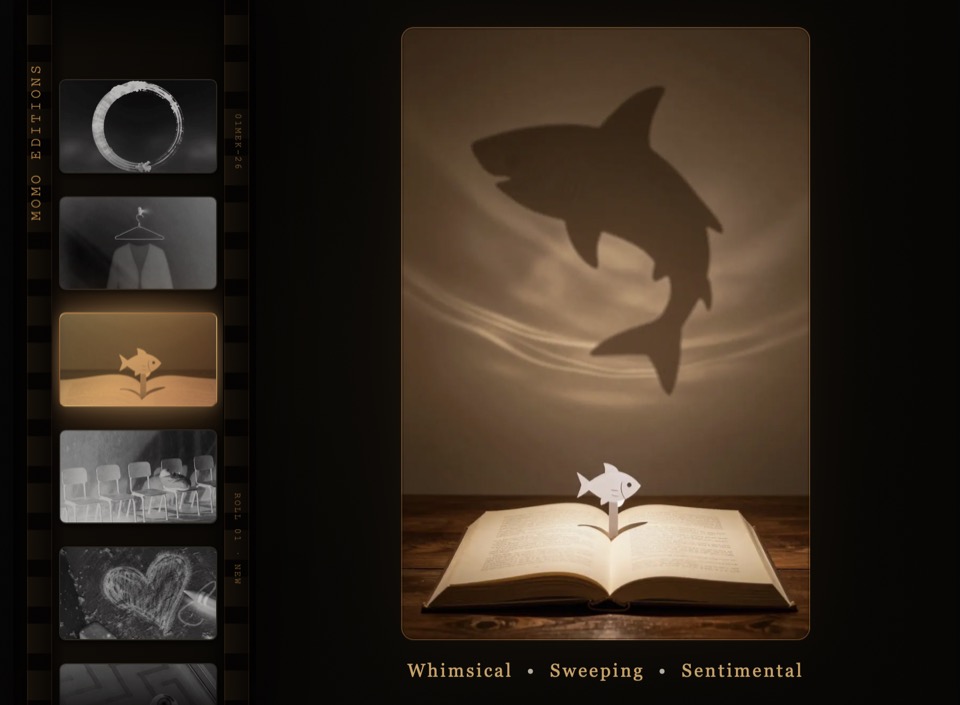
Normalized categories
Stable visual vocabulary scored for every image.
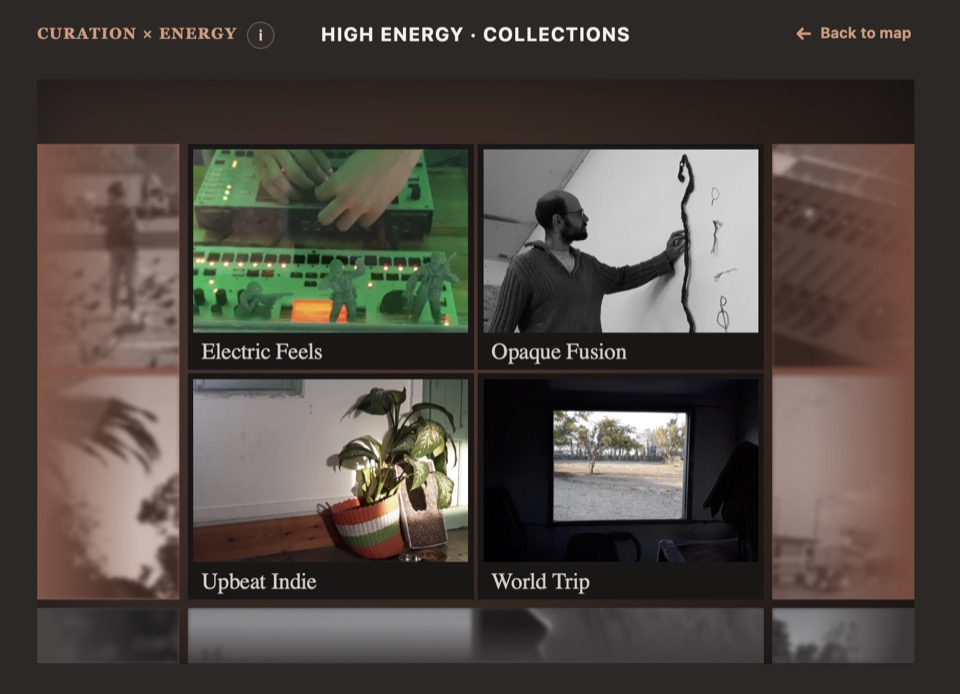
Contextual tags
Readable choices combine several categories and appear only where they help distinguish nearby images.
Step 4 — Guide the choice
Present the richer model through a continuous target, a few contextual refinements, explicit limitations, and ranked alternatives.
Continuous target
Comfort ↔ Stimulate sets the initial multidimensional profile.
Adaptive refinements
The most useful tag recipes adjust category targets without becoming another full taxonomy.
Hard limitations
Ineligible image records are removed before scoring.
Ranked alternatives
The engine retains eligibility, total scores, components, and calculated preference effects.

MomoMovies helps people choose a film by considering mood, viewing context, and available services.
MomoMovies helps people choose a film by weighing mood, viewing context, available services, and personal taste at the moment of choosing.
MomoMovies helps people choose a film by considering mood, viewing context, and available services.
MomoMovies helps people choose a film by weighing mood, viewing context, available services, and personal taste at the moment of choosing.

ListenLab is a private prototype for exploring music collections with more context.
ListenLab explores music collections through the relationships between songs, recordings, releases, playlists, and listening patterns.
ListenLab is a private prototype for exploring music collections with more context.
ListenLab explores music collections through the relationships between songs, recordings, releases, playlists, and listening patterns.

Momentum Management is a private prototype for seeing active work with more context.
Momentum Management gives active work more context across projects, tasks, inboxes, attention, and resumable state.
Momentum Management is a private prototype for seeing active work with more context.
Momentum Management gives active work more context across projects, tasks, inboxes, attention, and resumable state.
Meal Match treats choosing what to eat as a shared decision shaped by real constraints.
Choosing what to eat is often a coordination problem rather than a lack of options. Meal Match explores how preferences, energy, dietary constraints, time, and the people involved can shape a workable choice.
Meal Match is an early concept for making food decisions around real constraints.
Meal Match is an early concept for helping individuals or groups decide what to eat. It would bring preferences, context, and practical constraints together to move from indecision toward a workable choice.
Meal Match is early research into structured food-decision systems.
Meal Match is early product research into structured preference inputs, constraint matching, shared decisions, and recommendation logic. No application or functional prototype is available yet.
PathWise is an early idea about making route choices feel less demanding.
PathWise is an early concept for thinking about route choice in terms of the experience of getting there, not only the arrival time. Its questions and boundaries are still being defined.
PathWise is an early concept for more considered route choices.
PathWise is an early concept exploring how route choices might better reflect the conditions of a particular trip. Its identity, inputs, and product boundaries remain open.
PathWise is early research into context-aware route-choice systems.
PathWise is early product research into context-aware route choice. Its name, data assumptions, safety framing, and implementation boundaries remain open.
Chore Thing is an early idea about making household chores easier to choose and share.
Chore Thing is an early concept for making household chores easier to choose and share. Its questions around ownership, privacy, and collaboration are still open.
Chore Thing is an early concept for context-aware household chores.
Chore Thing is an early concept exploring how household chores might adapt to changing context. Its product identity and collaboration boundaries are still being defined.
Chore Thing is early research into context-adaptive household chore decisions.
Chore Thing is early research into context-adaptive household chore decisions. Its identity, privacy, ownership, and collaboration boundaries remain open.
Selected visual work and experiments from across Kahntra.